Browse

Log in / Register
 Share
Share
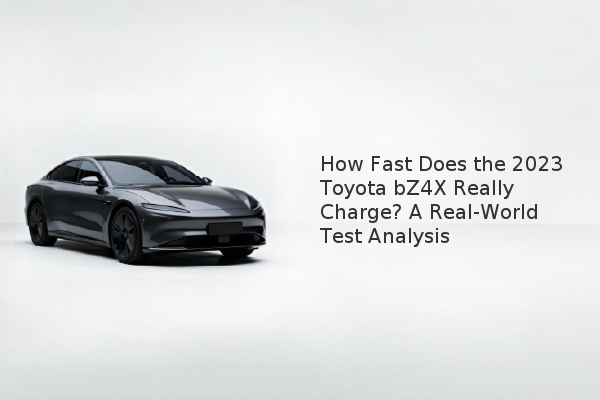
In a real-world test, the 2023 Toyota bZ4X took 54 minutes to charge from 25% to 80%—nearly double its official 30-minute claim—adding range at a rate significantly slower than key competitors like the Hyundai Ioniq 5 and Kia EV6. This performance highlights the importance of understanding real-world DC fast-charging speeds, which are crucial for road trips and emergency fill-ups, versus ideal manufacturer estimates.
Toyota states that under optimal conditions, a front-wheel-drive (FWD) bZ4X can use a DC fast charger to go from a 20% state of charge (when the low battery warning illuminates) to 80% in approximately 30 minutes. This is because the FWD model supports a maximum charging power of 150 kilowatts (kW), a unit measuring the rate of energy transfer. The all-wheel-drive (AWD) version has a lower maximum of 100 kW and takes about 60 minutes for the same charging session.
Our test of a 2023 bZ4X XLE with FWD yielded results far from Toyota's best-case scenario. Starting from 25% battery, it took 54 minutes to reach 80%, adding 141 miles of predicted range.
This rate was substantially lower than Toyota's estimate of up to 6 miles per minute. Several variables likely contributed to this discrepancy. The ambient temperature was 39 degrees Fahrenheit (4 degrees Celsius), and cold weather is known to reduce battery efficiency and slow charging speeds. Despite a 30-minute pre-charge drive to warm the battery and the car's DC charging setting being on "Max," the charging rate peaked at just 52 kW, well below the car's 150 kW capability.
When placed against other electric vehicles in its class, the bZ4X's real-world charging speed is less competitive. The following table illustrates the differences observed in various tests:
| Electric Vehicle Model | Test Conditions (Approx. SoC%) | Charge Time | Rate (Miles/Minute) |
|---|---|---|---|
| 2023 Toyota bZ4X (FWD) | 25% - 80% / 39°F (4°C) | 54 minutes | 2.6 |
| 2022 Kia EV6 | 23% - 84% / 29°F (-2°C) | 30 minutes | 5.4 |
| Long-Term Tesla Model Y | 20% - 80% / Similar Cold Temp | ~30 minutes | ~5.5 |
| 2023 Hyundai Ioniq 5 (RWD) | 18% - 80% / Warm Temp | 18 minutes | 9.0 |
Based on our assessment experience, models like the Kia EV6, Hyundai Ioniq 5, and Tesla Model Y consistently demonstrate faster charging capabilities, which can significantly reduce wait times on long journeys.
The answer depends heavily on your lifestyle and charging habits.
It's also important to note that frequent DC fast charging can contribute to long-term battery degradation. It is best reserved for situations where it's necessary, not as a primary charging method.
Beyond time, cost is a major factor. The test session cost $16.34 to add 141 miles of range. To put this in perspective, driving a 2023 Toyota Prius (57 mpg combined) the same 141 miles at current gas prices would cost approximately $8.57. This highlights that while electricity can be cheaper than gasoline, public DC fast charging is often more expensive than home charging and can sometimes narrow the cost-saving advantage of an EV.
The 2023 Toyota bZ4X is best suited for drivers who prioritize brand familiarity and will rely predominantly on home charging. Its conservative approach to performance and battery management may appeal to those seeking Toyota's reputation for reliability. However, for buyers who anticipate frequent long-distance travel or lack consistent access to a home charger, a competitor with superior fast-charging capabilities is likely a more practical and convenient choice. The bZ4X's real-world charging performance confirms it as an EV you'll want to keep close to home.